Tag Archives: phylloxera

Some Don’t Like It Hot: Using Heat to Reduce the Spread of Phylloxera into Non-Infested Vineyards in Australia

Phylloxera (Daktulosphaira vitifoliae Fitch) is one of the most destructive pests for grape vines.  Historically, it has wreaked havoc on vineyards around the globe, and nearly wiped out the entire grape and wine industry in Europe (and many other parts of the globe) starting in the 19th century.  (Side note: for a comprehensive historical account of the phylloxera crisis, check out this book that I reviewed earlier this year: Dying on the Vine: How Phylloxera Transformed Wine by George Gale).

There is no one method that is adopted globally to completely eradicate  phylloxera, however, there are two main approaches that are used to attempt to keep the pest at bay: 1) grafting Vitis vinifera vines on the phylloxera-resistant American rootstock; and 2) quarantine methods to reduce the spread of phylloxera into non-infested areas.  Most viticulture areas around the globe employ the rootstock method, however, in Australia; the quarantine method is the method of choice.  The remainder of this post will focus on phylloxera quarantine and eradication methods in the Australian wine industry.

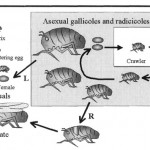
Photo from the Pests and Diseases Image Library:
http://old.padil.gov.au/pbt/files/uall/GP_lifecycle_from_Granett_et_al_2001_paper.jpg

Previous studies have found that phylloxera most often disperses to other vines and vineyards when it is in the first instar nymph life stage.  These are basically the creepy crawly baby phylloxera that has not yet matured into winged adults (in the image, see the white “crawler” highlighted critter).  Phylloxera at this stage is often in the vines and the leaves, and the risk for transferring these pests from one vineyard to another is highest during the spring and summer months when vineyard machinery is moving back and forth during their usual vineyard management programs.  These pests are tough little creatures, and are known to survive a lot of intense handling, including being squashed in between grape bins, and also the crushing, de-stemming, and pressing methods after harvest.

To minimize the transfer of phylloxera from infested to non-infested vineyards in Australia, strict quarantine methods are employed.  These methods include regulations for movement of machinery procedures, hygiene and cleaning procedures, and specific quarantine requirements.  Specifically, in Australia, there is a dry heat treatment requirement for all vineyard machinery which states that machinery needs to be kept in a temperature-controlled room at 45oC for at least 75 minutes or at 40oC for 120 minutes.

By Ji-Elle (Own work) [CC-BY-SA-3.0 (http://creativecommons.org/licenses/by-sa/3.0)], via Wikimedia Commons

Previous studies have shown that increased temperatures have an effect on phylloxera survival and development, though these studies more often focused on only one type of phylloxera (there are 83 known genotypes of the bug) or one geographical location.  Though there are 83 different genotypes, there are two that are particularly widespread and virulent throughout Australian vineyards:  “G1” is the phylloxera strain that is most widespread in Australia, and “G4” is the strain that is the most dangerous/harmful, and according to some are the two strains that provide the greatest threat to the Australian grape and wine industry.

The goals of the study presented today were to the minimum amount of time required for 100% mortality in phylloxera under different temperature and humidity conditions, to compare the impact of these conditions on the mortality of the G1 and G4 strains of phylloxera, and to confirm whether or not the current quarantine protocol for Australian vineyard machinery is effective in reducing the chance of further phylloxera infestations.

Methods

G1 and G4 strains of phylloxera were obtained from invested vineyards in the Yarra Valley and King Valley, Victoria, Australia.  Insects were confirmed to be one or the other strain by DNA microsatellite marker analysis.  Phylloxera were kept on Vitis vinifera roots until ready for use.  Eggs were incubated at a constant temperature for 5-7 days, and then newly hatched first instars of phylloxera were collected and used for the experiments.

Environmental chambers were created to maintain a constant temperature and humidity level.  Temperatures in chambers were kept between 30 and 45oC at 5oC increments with humidity levels at either 30% or 100%.  Separate chambers were used for each temperature and humidity combination.  20 newly hatched first instar phylloxera were placed in a vial with mesh on the ends to 1) prevent escape and 2) maintain air flow.  5 replicates of each vial were placed in each environmental chamber (100 instars per environmental chamber).

Instar survival was measured using a low-powered binocular microscope every 15 minutes for 30-120 minutes, depending upon the treatment.

Results

·         The highest temperature found to achieve 100% phylloxera mortality was 45oC regardless of humidity level.

o   The G1 strain exposed to 45oC achieved 100% mortality by 75 minutes at 30% humidity and by 90 minutes at 100% humidity.

o   The G4 strain exposed to 45oC achieved 100% mortality by 75 minutes at 30% humidity and by 60 minutes at 100% humidity.

·         At the 40oC temperature, 100% mortality was achieved at the 30% humidity level.

o   The G1 strain required 90 minutes to reach 100% mortality under these conditions.

o   The G4 strain required 105 minutes to reach 100% mortality under these conditions.

·         At 40oC and 100% relative humidity, 4% of the G1 strain survived and 7% of the G4 strain survived after an exposure time of 2 hours.

·         No other combination of temperature and humidity achieved 100% mortality for either phylloxera strain.

·         At 30oC and 30% relative humidity, survival was 60% for the G1 strain and 70% for the G4 strain.

·         At 35oC and 30% relative humidity, survival was 30% for both the G1 and G4 strains.

·         Temperature showed a significant effect on mortality of phylloxera.

·         Humidity did not have a significant effect on mortality of phylloxera.

o   The combined effect of temperature and humidity had a significant effect on mortality of phylloxera (though humidity alone had no effect).

·         There was no significant difference between the mortality rates of G1 and G4 strains of phylloxera at the different temperature and humidity combinations.

Conclusions

According to the authors, this is the first study that examined and showed the amount of time required to achieve complete mortality in first instars of

Photo attained from: http://upload.wikimedia.org/wikipedia/commons/thumb/a/a8/Phylloxera_cartoon.png/615px-Phylloxera_cartoon.png

phylloxera at different temperatures and humidity combinations (30oC, 35oC, 40oC, and 45oC; 30% and 100% relative humidity).  They were also able to confirm that the current quarantine protocol set forth by the National Vine Health Steering Committee in Australia of 45oC for 75 minutes exposure time or 40oC for 120 minutes exposure time are effective against the proliferation of phylloxera in non-infected areas.

The authors noted that with increased relatively humidity, the survival rate of the phylloxera instars went up.  They mentioned that this result shouldn’t be too worrisome, as the relative humidity in these designated “dry rooms” should not get much higher than 50%.  More work should be done to examine the survival rates of phylloxera at relative humidity between 30% and 50%, as these levels would be more likely to occur in one of these rooms than a relatively humidity of 100% as was tested in this study.  These results may determine if the regulations of in-room humidity control need to be strengthened or not.

It would also be interesting to see how other strains/genotypes of phylloxera survive under similar conditions.  Do the other 81 known strains have similar survival rates as G1 and G4?  Or are there some particularly tough strains that could take over once the competition was eradicated?  Even if those strains aren’t so common, they could be if they ever attained a competitive advantage.  Research into how to effectively quarantine these strains may be valuable for these reasons.

In general, the results of this study provide strong support for the procedures implemented currently for the quarantining of vineyard machinery in attempts to reduce or eliminate the spread of phylloxera into non-infested areas.  Further research could shed some light onto whether or not these methods may be effective in other locations around the world and may add an extra level of defense against the ever-present vineyard-destroying pest.

I’d love to hear what you all think about this research and the topic in general.  Please feel free to leave your comments!

Source: Korosi, G.A., Mee, P.T., and Powell, K.S. 2012. Influence of temperature and humidity on mortality of grapevine phylloxera Daktulosphaira vitifoliae clonal lineages: a scientific validation of a disinfection procedure for viticultural machinery.  Australian Journal of Grape and Wine Research 18: 43-47.

Book Review: Dying on the Vine: How Phylloxera Transformed Wine by George Gale

http://www.ucpress.edu/img/
covers/isbn13/9780520265486.jpg

Dying on the Vine: How Phylloxera Transformed Wine, by George Gale, is a highly educational and well-written book covering the phylloxera crisis starting in the late 1800s and how the world continues to struggle with the pest even today.  For over 150 years, this tiny little bug wreaked havoc on grape vines all over the world, the details of which this book describes the steps that were taken initially in France and the lessons learned (or not learned) by other grape growing regions around the world.  This book will appeal to anyone in the wine industry, as well as ecologists, entomologists, historians, and generally anyone interested in human behavior in times of crises.

The first half of the book (Chapters 1 through 4) takes the reader on a journey through time starting from the very first discovery of what was to become known as the phylloxera crisis in France through the controversial attempts at eradicating the pest.  Was the phylloxera bug the cause of the vine death?  Or was there an unknown disease already weakening the vines that attracted the pest?  Surprisingly, this debate went on for many years, with scientific research to back up such claims at times falling far behind.

Over time, several “solutions” to the phylloxera problem were employed in France, including planting in sand, vineyard submersion, and sulfiding.  Though these methods worked some of the time, none of them were long-term strategies that would be effective against the phylloxera worldwide, nor were some of them particularly good for the environment (re: sulfiding).  Over the next few decades, the best minds at the time eventually determined that they only way to effectively stop the phylloxera from spreading all over the country and destroying all of the vineyards (and ultimately the only source of income for many families at the time) was to graft the vines onto American rootstock.

Of course, since it was ultimately discovered that imported American vines were the cause of the initial phylloxera outbreak to begin with, acceptance of this grafting onto American rootstock method caused much contention and controversy throughout the French countryside.  Over time, however, this proven method was eventually embraced by vineyards across the country, though there would always be some debate about whether or not a better method existed that would keep French vines “pure”.

Chapters 5 and 6 describe how the phylloxera spread throughout Europe, Australia, and South Africa, and details how each country took to solving the crisis.  One would think that each country would simply look at what happened with the French vines and learn from their mistakes, however, the book describes how surprisingly many of the locales would put up a “it can’t happen here” front and completely ignore any of the work done previously in France.  It was as if each location that was affected by the bug was starting from scratch, with no one wanting to believe that this disaster could happen to them.  The book provides fascinating descriptions and insight into how each country handled the situation, and makes one think about human behavior in crises and the ability (or inability) to learn from past mistakes.

Chapter 7 takes us back to France and describes how French people during this time were taking to the new American rootstock and the American vines planted on French soil.  Though many detested the “foxy” wine produced from these American vines, many people realized their choices were limited and gradually learned to enjoy the beverages.

Finally, Chapter 8 describes how phylloxera broke out not once, but twice, in California and how people in America struggled with finding a solution just as much as the Europeans, Australians, and South Africans did regarding how to handle the eradication of the bug.  From reading the book, it amazed me how much different cultures ignored the mistakes and successes of other cultures regarding the phylloxera crisis and how foolishly proud each was.

Overall, I thought this was a fantastic book and was a great read from cover to cover.  I even found myself reading each of the three appendices, which is something I wouldn’t normally do if I did not enjoy the subject matter or the author’s writing abilities.  This book made me curious as to how this crisis affected the overall psychology and health of the people involved, which is a topic of interest of many scientific research studies, including one summarized here on this blog.  Since the focus of this book was on the ecological/viticultural side of things, I knew not to expect answers to these questions; however after reading this book by George Gale, I want to know more!

If you’re at all interested in the history of wine, ecology, entomology, or just overall good writing, I highly recommend picking up a copy of this book! 

You may purchase is on Amazon by clicking on this link:  Dying on the Vine: How Phylloxera Transformed Wine

 …or you may buy it directly from the publisher by clicking here:  Dying on the Vine: How Phylloxera Transformed Wine

Happy reading!
I am not a health professional, nor do I pretend to be. Please consult your doctor before altering your alcohol consumption habits. Do not consume alcohol if you are under the age of 21. Do not drink and drive. Enjoy responsibly!

A Closer Look into History: The Phylloxera Crisis in France and Long-term Health Impacts

Today’s review paper topic ties in issues related to viticulture, health, history, and finance.  Carried out by a group at the Massachusetts Institute of Technology (MIT), this post presents a paper looking at possible long-run health impacts of “income shocks” related to wine and the phylloxera pest in late 19th century France. 

How could a sudden drop in income effect long-run health?

http://www.scienceclarified.com/images/uesc_06_img0351.jpg

Studies have shown that poor environmental conditions in utero have adverse effects on long-term health outcomes, including life expectancy, height, cognitive abilities, and overall productivity.  Many environmental factors can influence the severity of damage regarding the aforementioned health outcomes, including the disease environment, public health infrastructure, food availability, and certain seasonal nutrients.  Studies have also shown that for developing countries, the nutritional state of children is affected by the income of their family.  Therefore, in developing countries, it is speculated that financial crises may have long-term health impacts on children born during that period of stress, though there have not been enough studies to confirm or refute this idea.

The aim of the study presented today was to look deeper into the phylloxera crisis in 19th century France, and examine whether or not the income shocks associated with this sudden drop in grape and wine production had any long-term effects on the health of those that were born during that period of time.

Phylloxera and 19th Century France

http://www.sibbus.com/uploads/RTEmagicC_LAUSWING03_02.JPG.jpg

Phylloxera, an insect of the aphid family, attacks the roots of vines, which causes dry leaves, a reduced yield of fruit, and ultimately the death of the plant.  Native to North America, the insect is thought to have arrived in France in the early 1860s, either in the wood used for packaging materials from the US to France, or in a shipment of American vines.  The pest had two points of establishment, one on the southern coast of France near the mouth of the Rhône, and the other on the west coast in the Bordeaux region.  The insect spread relatively quickly, moving northward up the Rhône and outward along the coast, as well as southeast along the Dordogne and Garonne rivers and north to the Loire valley, all by 1878.  By 1885, the phylloxera pest had reached Paris.

http://www.winetitles.com.au/diagnosis/images/problems/193.jpg

When the phylloxera first arrived, no one knew exactly what the cause of the plight was, since it was a completely new occurrence for them.  As it spread, and after nearly 40% of the vineyards in France were destroyed, it was apparent that it was causing a huge decrease in production, and a commission to investigate was formed.  After discovering the cause of the dying vines was the phylloxera pest that destroyed the root structure, a solution was found in the 1880s, which was to graft the phylloxera-resistant American vine root stock onto the European vines.  As a result of this discovery and solution implementation, the European vine recovery was well on its way, with eventually 4/5 of the vineyards in Europe being replaced with the new grafted vines.

Economy of Wine in 19th Century France

Before the phylloxera infestation, 1/6th of French agriculture income came from wine, which was produced mainly in several small highly specialized wine growing regions.  The authors of the study presented today estimated that the loss in agricultural income during the phylloxera crisis was about 16-22% in the wine producing regions of France (which is a major income shock).

Instead of facing major wine shortages in France, government officials relaxed wine import rules, so that the prices of wine did not change to reflect the decrease in grape production during the phylloxera crisis.  For example, in the 1860s (before the phylloxera crisis), 0.2 million hectoliters of wine were imported from places other than France.  After relaxing import rules as a result of the phylloxera crisis, 10 million hectoliters of wine were imported in the 1880s.  After replacing the European vines with the new phylloxera-resistant grafts, the wine importation rules were once again implemented, and wine imports decreased in the 1890s.  This effectively kept the prices of French wine rising as fast as the production was decreasing. 

http://www.weimax.com/images/Phylloxera_Poster_France.gif

With a huge decrease in production and no increase in wine prices, the phylloxera crisis was therefore a huge income shock for those producing wine at the time.  Without yearly data on overall agricultural production, it cannot be determined what the overall drop in GDP was during the phylloxera crisis.  However, there is reason to believe there was no switch from wine production to any other agricultural activity (such as wheat production) by wine growers affected by the phylloxera, therefore the decline in wine production led to a overall decline in income for wine producers.  This trend has been confirmed in other studies related to the phylloxera crisis in France.  The total loss of income in the wine-producing regions on France during the phylloxera crisis was between 16-22%.

Methods:  Health Information and Measurement

In the late 19th century, France could be considered a developing country.  The female life expectancy in 1876 was 43 years old, infant mortality was 22%, and the average height of males at the age of 20 was 1.65 meters (5 feet, 5 inches).  Height has been shown to be a relatively good measure of overall health, and it has been shown to be correlated with other adult outcomes.

To acquire health information for those individuals born during the phylloxera crisis in the late 19th century France, the authors of the study went to military data sets for numbers.  Since 1798, men had to report for military service in the year they turned 20 in the region where there father lived.  It is then that health information (including height measurements) was recorded.  Rejections due to health reasons (including being too short) were recorded as well.

Many mathematical models were used to determine the results of this study after controlling for many potential influencing factors, and will not be presented in this summary post; however I am happy to present that information to you, should you be interested.  Simply comment below with questions.

Results

Effect of Phylloxera-induced Income Shocks on Height

  •       At the age of 20, those born in wine-producing regions that lost all of its production due to phylloxera would be 3.2 mm shorter than those born in other regions.
  •       Those born in wine-producing regions that lost 80% of its production due to phylloxera would be 1.9 mm shorter than those born in other regions.
http://4.bp.blogspot.com/-ohiKFKgCzqU/TVRdc4ru7gI/
AAAAAAAAARc/_s6SEA00TE0/s1600/short_vs_tall.gif
  •       A drop of 10% in a wine-producing regions’ income would result in a decrease of 1.06-1.9mm in height.
  •       In wine-producing regions, 1 more hectare of vineyard per capita increases the probability that a 20 year old male born in years where production was at least 20% lower due to the phylloxera crisis is shorter by 1.85% and reduces his height by 7mm.
  •       A child born into a wine-producing family during the phylloxera crisis was 0.5 to 0.9 cm shorter by the age of 20 than he/she would be otherwise.

o   Considering than overall heights in France during that time grew only by 2cm, that effect is a large one.

  •       The probability of being rejected for military service due to short height was 1.5% higher for each additional hectare of wine per capita in a wine-producing region.
  •       There were no long-term height effects on young children 1-2 years old), toddlers (2-5 years old) or teenagers who were born before the phylloxera crisis hit.

Effect of Phylloxera-induced Income Shocks on Other Health Outcomes

·         There was no effect on mortality or life expectancy as a result of phylloxera-induced income shocks in late 19th century France.

·         The number of men rejected for military service for health reasons is actually smaller for those effected by phylloxera (though it’s uncertain what exactly the health reasons were, and there is a potential for sampling bias in this study which may alter the results slightly).

·         Overall, there is no evidence of a negative long-term impact of the phylloxera crisis on any health condition, other than height.

What does this all mean?

Since the only health outcome apparently affected by the phylloxera crisis in 19th century France was height, the authors speculated that it was most likely due to nutritional deficits during childhood, and not necessarily due to stress in utero.  Overall health status may have been protected by other factors, such as decent public health infrastructure, which alleviated any potential health risk often associated with income shocks.

Since those in wine-producing regions were often wealthier with a high social status compared to those living in other regions, it is possible that the loss in income was not significant enough to cause much stress in utero, which would have had negative effects on long-term health outcomes.  Perhaps those in wine-producing regions were more able to recover from a loss in income than a poorer individual working in other industries in France at that time.

In summary, it appears that stress in utero has negative effects on health outcomes in adulthood, however, the income shocks due to the vine-damaging phylloxera crisis was not enough to illicit such a response.  Perhaps those families affected were wealthy enough to withstand the blow without harsh consequences, or perhaps all of the wine being consumed kept everyone in a happy, stress-free state!

Please feel free to comment below!  I’d love to hear from you!

Full citation for the article discussed today:

Banerjee, A., Duflo, E., Postel-Vinay, G., and Watts, T. 2010. Long-run health impacts of income shocks: wine and the phylloxera in nineteenth-century France. The Review of Economics and Statistics 92(4): 714-728.

I am not a health professional, nor do I pretend to be. Please consult your doctor before altering your alcohol consumption habits. Do not consume alcohol if you are under the age of 21. Do not drink and drive. Enjoy responsibly!