
Tag Archives: wine temperature

Wine Technology of the Future: Corkscrew with an Integral Intelligent Thermometer


It’s always fascinating to see what new products are being invented and patented in regards to wine technology.  Previously on The Academic Wino, I presented the “Self-Aerating Wine Bottle” in the first installment of “Wine Technology of the Future”.  Today’s featured patent comes to us by the inventor Debra Harris Fogel, and is named the “corkscrew with integral intelligent thermometer”.

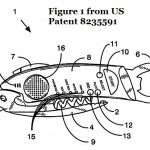
The patent for the “corkscrew with integral intelligent thermometer” (US8235591) was first filed in October 2003 and was finally issued in August 2012.  Briefly, this corkscrew was designed to not only open the bottle of wine, but to also inform the consumer what temperature the wine currently is, as well as what wines would be best at that temperature.  The device is designed in such a way that this information may be transmitted by audio and/or visually by a digital display.  Temperature is measured either from a probe on the outside of the bottle (think a probe in the handle of the corkscrew) or via the screw itself once it was inserted into the cork.

Figure 1 from US Patent 8235591

Note: This figure illustrates the corkscrew with integral intelligent thermometer.  Temperature probes are located at #2 and the corkscrew itself.

Why was this device invented?

According to the inventor, this corkscrew with the integral intelligent thermometer was designed to assist consumers in determining the proper temperature at which a wine should be served.  Studies have shown that different wines have different optimal serving temperatures, which are dependent upon a variety of factors, most notably the color of the varietal (red, white, or rosé).  For the inexperienced consumer, who makes up a large number of the consumer population, the knowledge of exactly what temperature (or temperature range) a particular wine should be served is not part of their memory banks.  By having a corkscrew tell one at what temperature they should be serving their wine, it eliminates the stress and worry that they might not be serving it properly.

The author also cites the entertainment value of the device.  According to Harris, having a corkscrew talk to you and tell you what temperature your wine is, or what temperature your wine should be, it provides a level of entertainment that will encourage the consumer to use it over and over again.  To be honest, while I think it’s a novel idea and probably “fun” the first few times I used it, I would be more likely to be entertained each and every time if I could change up the voice that calls out the temperature to me.  Just imagine some celebrity like Mr. T telling you what temperature your wine is:  “It’s 2oC!  I pity the fool who serves their wine so cold!” (Mr. T. pictured below)

By Annie Mole [CC-BY-2.0 (http://creativecommons.org/licenses/by/2.0)], via Wikimedia Commons

Harris also made mention of the fact that having a device give you the temperature of the liquid within the bottle without actually opening the bottle would be optimal.  I completely agree, as if one opens the bottle and finds out it’s the wrong temperature, it’s harder to get back in the refrigerator without risking leakage from the cork (ok, it’s actually not that hard, but one does run the risk of leakage if the bottle is placed on its’ side).  By having the temperature probe on the arm of the device, the temperature is able to be read through the side of the bottle.  Similarly, by having a probe on the screw itself, the temperature inside the bottle can be measured without breaking the seal of the corkon the sides of the neck (though now there is a hole in the top of the cork…).

Figure 2 from US Patent 8235591

Note: This figure highlights the digital screen where the temperature readout would be located.

Would you buy it?

In general, I think it is a pretty neat little gadget, and may be useful for technology geeks that want to be certain they are serving their wine at the correct temperature either to truly taste the wine at the temperature it was designed to be served at, or to just impress their friends at their next dinner party.  I technically wouldn’t need this device, since I have a wine refrigerator by which I can set the precise temperature to store my wines, however, it would be useful if for some reason I wasn’t sure if my refrigerator was accurately reporting temperature anymore, or, if I just wanted Mr. T to yell at me to warm up or chill down my wine.  OK, OK, Mr. T’s voice is not available on this device, but I would buy it in a heartbeat if it were!

What do you all think of this new device?  Would you buy it?  Is it just a marketing ploy that people don’t REALLY need?  Do you think it helps or hurts the wine business?  Please feel free to leave your comments!

Source:  US Patent: US8235591  http://ip.com/pat/US8235591  Accessed 11/11/12

Evidence for Damaging Effects of Heat Exposure on Wine During Transport and Storage and Recommendations for Protection

It is well known that long term heat exposure is detrimental to the quality of wine, specifically its sensory characteristics and ability to age.  Excessive heat can also alter a wine’s physical and chemical stability, such as showing a cloudy or brownish appearance and leaking bottles.  To date, most of the evidence for the damaging effects of heat on wine storage is anecdotal, with very little concrete scientific evidence backing up the claims.

http://www.restaurantowner.com/
public/images/336.jpg

A bottle of wine being transported from winery to consumer risks many abusive shipping processes along the way, including excessive heat exposure.  This risk is exacerbated at times by high shipping costs, limited availability of refrigerated shipping containers, and general ignorance.  Many winemakers have even adjusted their production techniques in order to protect their bottles of wine from heat exposure, including deliberately oxidized and fortified; red wines that underwent extended maceration; and distilled wines.  Nearly all commercial white wines are heat stabilized during the winemaking process, so that heat exposure does not result in a visual change in the wine (haziness).

Even if heat exposure doesn’t damage the wine per se, the ageing characteristics will be changed following a certain time of elevated temperatures.  Specifically, heat exposure can prematurely release glucose-bound flavor precursors, decrease the levels of protective free sulfur dioxide, and cause an increase in browning.  The sensory character could be changed as well, though due to rapid heating and specific reactions of the many compounds in wine, it’s not certain that the “ageing” due to increased heat exposure would be the same as if that wine were aged for a comparable amount of time at a more traditional storage temperature.  It is likely that at least the subtle differences attributable to terroir would be lost.

One potentially hazardous consequence of increased heat exposure to wine while in storage is the formation of ethyl carbamate (EC).  Based on experiments with rodents, it has been shown that there is a probability of a carcinogenic effect of EC in humans when exposed to high concentrations of the compound.  In wine, EC is formed from its precursor, Urea, which is naturally present in wine from 100μg/L to 100mg/L.  Urea can be released by wine yeasts during or at the end of alcoholic fermentation, which then can spontaneously react with alcohol to produce EC.  This reaction between Urea and alcohol to make EC has been shown to accelerate exponentially when excessive heat is applied.  Therefore, excessive heat during storage of wine is a great concern.

The study presented today used EC levels as an indicator of wine quality in order to demonstrate the chemical changes that occur in wine during transport and storage.  The goal of the study was to provide wine makers and producers with information on how to properly handle their wines in regards to transport and storage as they work with transport companies, distributors, wholesalers, and retailers in order to minimize the exposure of their wines to excessive temperatures during this transitional period.

Methods

The wine used for this experiment was a model wine, containing 10mg of urea, 5g of potassium bitartrate, 3g L-malic acid, 1.1g potassium monohydrogen phosphate, and 150mL ethanol, brought to volume by adding de-ionized water.  The resulting pH was 3.5.

Temperatures were tracked and recorded using Dickson SP100 dual-channel temperature data loggers.  An internal temperature sensor recorded the air temperature inside the test package, and an external thermistor was placed inside a wine bottle filled with de-ionized water.  Temperatures were recorded every 15 minutes.

The test packages were created by loading a standard 12 bottle case with one bottle of model wine, one bottle of de-ionized water containing the thermistor, and the rest of the case fitting the data logger.

Test packages were shipped via truck or rail, in standard non-refrigerated containers with non-insulated walls.  Wine cases were assembled onto pallets, with the top of the pallets covered with thermal blankets (fabric quilts or plastic/metal bubble wrap) for insulation.

Test packages were placed in the shipping container in three different positions per shipment: one above the thermal blanket, one in the front of the pallet below the blanket, and one in the back of the pallet below the blanket.

There were 26 individual shipments containing a total of 47 test packages monitored in the summer and fall of 2000 during 13 different shipments throughout the US.  Wines were shipped via truck or rail from winery warehouses in California to wine distribution centers in Georgia, Texas, New York, California, New Jersey, Illinois, Florida, Missouri, Louisiana, and North Carolina.  Upon arrival, test packages were removed from their pallets and returned to California via USPS Priority Mail for chemical analysis.  Wines were in transport for a total of 1 to 3 weeks.

Upon return to California, wines were sent to ETS Laboratories for chemical analysis.  EC was analyzed by gas chromatography and mass spectroscopy.

Heat exposure of wines was calculated by integrating the temperature data for each 15 minute intervals and comparing them to ideal cellar storage conditions.

Results

  •       Temperatures ranged from -13oC to 44oC in the top (unprotected) position.

o   The freezing point of table wine is -5oC.

o   Volume expansion of table wine from 13oC to 44oC is 0.9% or 7mL per 750 mL bottle.

o   Normal headspace volume at bottling is between 4 and 7mL.

  •       There was a 2 to 4oC temperature difference between the temperature of the air in the storage space and the temperature of the liquid inside the bottle.

o   Therefore, the heat capacity of the glass protects the wine from short-term temperature spikes.

  •       Temperature changes during 1 day in the unprotected top position ranged from 4oC to 21oC.

o   This temperature fluctuation could result in significant volume expansion of the wine which could affect the structural integrity of the closure and glass.

  •       There were significant temperature differences between test packages, depending upon where in the container the test package was located.

o   All extreme temperatures occurred in the top location that was unprotected; indicating that wine shipped without additional protection (i.e. blankets) will be more prone to extreme heat exposure and variation between bottles in a single shipment.

  •       EC formation in model wines was found to be between 2 and 94 μg/L during the shipping period tested.

o   This resulted in a 10-fold increase in reaction rate every increase of 19oC.

  •       Heat exposure to the wines significantly increased the effective bottle age and wine shelf life.

o   The true age of the wine jumped forward by 18 months (1.5 vintages).

o   This accelerated aging will likely lead to different wines in terms of sensory characteristics than what they would be under normal aging conditions.

Conclusions

The results of this study showed that extreme heat exposure has potentially damaging effects on the stored wines.  However, current commercial shipping technologies can be sufficient in protecting wines against heat damage, as long as certain rules and procedures are applied each time.  For example, the use of insulation in shipping containers is critical in protecting wine against excessive heat.  Since wine bottles are heavy, they are usually packed at the bottle of the shipping container, which leaves a good amount of headspace above it.  As this study showed, the headspace is prone to excessive heat fluxes, so by insulating the shipping containers, this increase in temperature of the headspace can be hampered.

One concern about these protective measures is that the cost is too much to bear for wineries.  According to the authors of this study, the additional cost for different transport options, including special refrigeration units or protective blankets, usually adds no more than 0.1% to the production cost of even the most inexpensive wines.  Those red wines that are heavily extracted and considered to be very precious are actually the ones that are least apt to be damaged by heat exposure, due to their high abundance of protective phenolic compounds.

One part of the system that this study did not cover that could cause significant damage to the wines due to heat exposure is the time when wines are moved from small un-insulated delivery trucks to the consumers’ doorstep (or some other similar end of transport situation).  There isn’t too much that can be done at this point, other than packaging the wines in protective/insulating case boxes and not shipping during the hottest months of the year.  Overall, however, damage to wines caused by excessive heat exposure can be avoided mostly by ensuring proper protection in the shipping containers during transport and storage.

One thing I’d like to see a similar experiment with actual wine instead of model wine.  Since “real” wine contains many more compounds than the model wine in this study, do the chemical reactions therein change how the wine is affected by the heat?  The authors alluded to the fact that a heavier wine with higher levels of phenolic compounds would suffer less than other wines, so it would be nice to see this backed up with some data.  Also, were the EC fluctuations found in this study enough to be harmful to humans if consumed?  Or did the levels remain below any sort of threshold level?

I’ve love to hear what you all think about this topic.  Please feel free to comment below (no html tags, please).

Source: Butzke, C.E., Vogt, E.E., and Chacón-Rodríguez, L. 2012. Effects of heat exposure on wine quality during transport and storage. Journal of Wine Research 23(1): 15-25.


I am not a health professional, nor do I pretend to be. Please consult your doctor before altering your alcohol consumption habits. Do not consume alcohol if you are under the age of 21. Do not drink and drive. Enjoy responsibly!