Monthly Archives: February 2013

Could UV-Irradiation Replace Sulfur Dioxide in Wines?


—————————————————————————————————-

Welcome to The Academic Wino! If you are new here, please read the “About Me” page to find out more about myself and the blog. If you would like to receive free updates on articles like this by email, then sign up here or you can subscribe to the RSS feed. Also, check us out on Twitter, Facebook, Google+, and or Pinterest. Thanks for visiting!

—————————————————————————————————-

There are many things that can have an effect on the quality and stability of wine. Specifically, both enzymatic and non-enzymatic oxidative reactions can significantly influence the aromatic and structural quality of a wine, which without appropriate control, can run rampant and cause off-aromas and flavors in the wine, thus spoiling the beverage. Spoilage microorganisms (such as certain yeasts and bacteria), as well as compounds naturally present in wine can cause oxidation reactions or become oxidized themselves, resulting in undesirable sensory characteristics in the finished wine.

In order to control these spoilage microorganisms and undesirable chemical reactions, winemakers have historically (and currently) employed SO2 (sulfur dioxide) during the winemaking process. In recent years, however, there has been a strong push for winemakers to reduce their usage of SO2, stemming

By inspector_81 (originally posted to Flickr as IMG_1381) [CC-BY-SA-2.0 (http://creativecommons.org/licenses/by-sa/2.0)], via Wikimedia Commons

By inspector_81 (originally posted to Flickr as IMG_1381) [CC-BY-SA-2.0 (http://creativecommons.org/licenses/by-sa/2.0)], via Wikimedia Commons

partly from the finding that SO2 exposure could be a health risk for certain individuals. Currently, there isn’t one compound or product that can completely replace SO2 in winemaking, though research is ongoing and has already found that reducing the amount of SO2 used in conjunction with another alternative technology could protect the finished wine just as well as higher levels of SO2 used alone. These alternative technologies include hydrostatic pressure, pulsed electric fields, ultrasound irradiation, and UV (ultraviolet) irradiation.

The study presented today aimed to examine the use of UV irradiation as a protective agent against wine spoilage, while comparing with SO2 and no treatment controls. The measure for determining if any of the treatments protected against wine spoilage or oxidation was polyphenol oxidase activity. Polyphenol oxidase is partially responsible for the browning of white wines after oxidation, so theoretically, if polyphenol oxidase levels are decreased, the wine is not oxidized (or is less oxidized) than a wine with higher polyphenol oxidase levels.

Methods

Two white grapes were used in this study: Xarel-lo and Parellada (from vineyards in Spain). Grapes were processed in a home juicer and then pressed. To remove any solids, juice samples were centrifuged then the liquid removed. The juice was then split, with half remaining as fresh juice and the other half going into a freezer. For both fresh and frozen juice, samples were split into the following treatments: 1) SO2 addition (50 mg/L potassium metabisulphite) prior

By Ben Mills (Own work) [Public domain], via Wikimedia Commons

By Ben Mills (Own work) [Public domain], via Wikimedia Commons

to winemaking; 2) UV irradiation treatment prior to winemaking; and 3) winemaking without SO2 or UV treatments (control).

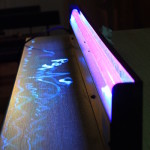
UV irradiation occurred in a dark chamber that housed the juice and a lamp. The irradiation treatment lasted 3 hours and 30 minutes, with samples taken at 0, 60, 120, 180, and 210 minutes.

Winemaking occurred at the Raimat winery in Lleida, Spain. 500mL of each treatment must were placed into a separate glass bottle. Fermentation occurred within these glass bottles using a commercial yeast.

The following analyses were performed on the samples: pH of the must before and after UV irradiation; pH of the wine; soluble solids content; color of musts and wines; tartaric acid content; alcohol content; volatile acidity; and polyphenol oxidase activity.

Results

• In untreated musts, Xarel-lo musts had higher levels of soluble solids than Parellada musts.
• Polyphenol oxidase activity was decreased in all UV irradiation samples.
o The level of polyphenol oxidase activity remained at 18% +/-1 of its original activity in Xarel-lo samples and at 30% +/- 1 in Parellada samples after UV treatment.
• Polyphenol oxidase activity was completely deactivated by SO2 treatment.
• Polyphenol oxidase activity inactivation was the same for both fresh and frozen samples of grape varieties (i.e. no statistical differences in inactivation between fresh and frozen samples).
• Inactivation constants were higher for Xarel-lo samples than Parellada samples, which the authors attributed to an increased denaturation ability of the enzyme in Xarel-lo samples compared with Parellada samples.
o Inactivation constants were statistically similar between fresh and frozen samples of both grape varieties.
• UV irradiation alone did not cause any change in brightness (color) in any sample.
o In Xarel-lo musts, fermentation caused a decrease in brightness in samples that had been previously irradiated, but not for those treated with SO2.
o In Parellada musts, fermentation caused a decrease in brightness in samples that had been previously irradiated and in untreated samples.
o Frozen musts were less bright after thawing than fresh musts.
• In terms of redness, the freezing and thawing process increased the redness of the sample.
o Wines from UV treated musts were redder than wines from SO2 treated musts.
• In terms of yellowness, untreated frozen samples showed an increase in yellowness (the trend was not seen in UV treated samples).
o In Xarel-lo wines, fermentation of frozen and thawed musts resulted in a decrease in yellowness that was not found in any other treatment.
o In Parellada wines, UV treated musts created less yellow wines than wines made from SO2 treated musts.
• There were no significant differences between any of the treatments in regards to absorbance spectra.
• UV irradiation treatment samples fermented at a slower rate than SO2 treatment samples, which the authors attributed to the decrease in natural microflora caused by UV irradiation.
• There were no significant differences found between any of the samples in regards to density evolution through the winemaking process.
• In terms of enological parameters:
o Freezing and thawing resulted in Xarel-lo wines with lower pH, higher tartaric acid, and higher volatile acidity.
o In Parellada wines, pH was higher in wines made from frozen and thawed musts as well as UV treated musts, however, no in wines made from SO2 treated musts.

Conclusions

The authors of this study reported that based on the results, they can conclude that UV irradiation can partially decrease polyphenol oxidase activity in the white wines Xarel-lo and Parellada. It is important to note that UV treatment did not completely eliminate polyphenol oxidase activity as it did with SO2 treatment, but as the authors mentioned, it could potentially be utilized in concert with reduced SO2 levels.

Though the results of this study are interesting, the results only raise more questions for me. First of all, polyphenol oxidase, while a very important contributor to wine spoilage (in terms of oxidation and browning), it’s not the only one. The authors themselves mentioned a couple other enzymes responsible for wine spoilage, including laccase and peroxidase, though we don’t know how UV irradiation would affect the activity of these browning enzymes.

The authors also mention toward the end of the paper that UV light has historically been shown to have negative consequences on wine, but that those papers only looked at UV exposure on finished wine, and not on the musts prior to fermentation. That’s all well and good, but why would you bother saying that and not present us with the comparison? Wine goes bad with UV exposure, so

By Tarvo Metspalu (Own work) [CC-BY-SA-3.0 (http://creativecommons.org/licenses/by-sa/3.0)], via Wikimedia Commons

By Tarvo Metspalu (Own work) [CC-BY-SA-3.0 (http://creativecommons.org/licenses/by-sa/3.0)], via Wikimedia Commons

why wouldn’t the same thing happen with the musts-turned-wine? The authors give no explanation to why they think treating the musts wouldn’t yield the same negative consequences on the wine as it does when exposed to finished wine. Maybe the mechanism and effects are different, but one really shouldn’t make a statement like that unless they are prepared to step up with some results.

After all this talk of wine spoilage, browning, and protection against spoilage and off-aromas or flavors, the study is strongly lacking in any sort of sensory analysis of the finished wines for each treatment. If the primary outcome is strongly tied to aromatic quality, why not have a sensory analysis? I’d be very curious to see how UV irradiation affected the flavor and aroma of the finished wine, particularly after the authors made the statement that UV exposure of finished wines has been shown to have negative sensory effects.

Overall, this study is a good start; however, there are several issues that should be addressed in a follow-up before I am convinced UV irradiation is an appropriate treatment for combating oxidation or spoilage in wines.  Don’t give your wines a tan just yet!

What do you all think of this study? Do you see any other problems with the study? Am I being too harsh? What sorts of follow-up experiments or studies would you like to see?

Source: Falguera, V., Forns, M., and Ibarz, A. 2013. UV-vis irradiation: An alternative to reduce SO2 in white wines? LWT – Food Science and Technology 51: 59-64.

Climate Change-Induced Water Stress: How Leaf Position Affects Water Use Efficiency in the Grape Vine

—————————————————————————————————-

Welcome to The Academic Wino! If you are new here, please read the “About Me” page to find out more about myself and the blog. If you would like to receive free updates on articles like this by email, then sign up here or you can subscribe to the RSS feed. Also, check us out on Twitter, Facebook, Google+, and or Pinterest. Thanks for visiting!

—————————————————————————————————-

According to scientists, climate change will affect various parts of the world differently than one another. Specifically, in regards to the Mediterranean region (as well as many others), a decrease in annual precipitation is currently predicted, based on past data and future forecast models. As a result of this predicted change, there has been substantial interest in research related to water use efficiency in both viticulture and agriculture in general, as precipitation changes will likely bring changes to the sustainability and quality of crops, so determining how to adapt to these changes is absolutely necessary for the future of viticulture and agriculture as a whole.

This type of research is not exactly new, and has been going on for many years. Current strategies for combating decreased water availability due to climate change include (but are not limited to) controlled irrigation and partial root zone drying. The problem with using irrigation in a climate that has significantly

By Photo by Lynn Betts, USDA Natural Resources Conservation Service. (USDA NRCS Photo Gallery: NRCSCA00061.tif) [Public domain], via Wikimedia Commons

By Photo by Lynn Betts, USDA Natural Resources Conservation Service. (USDA NRCS Photo Gallery: NRCSCA00061.tif) [Public domain], via Wikimedia Commons

reduced precipitation is the issue of where the water used for irrigation would come from. To work around this issue, scientists are currently looking at plant water use efficiency, and how pruning or other viticulture strategies can optimize plant water use in such a way that the need for supplemental irrigation is reduced. Of course, there are some “issues” with looking only at water use efficiency, as higher water use efficiency has been linked to lower fruit yield in grapevines. Therefore, optimization, and not necessarily maximization of water use efficiency is key.

The goal of the study presented today was to examine variations in leaf water use efficiency in the grapevine (Tempranillo, to be specific) under water-stressed conditions as well as under different light conditions, as well as throughout different parts of the canopy.

Methods

This study took place at a commercial vineyard in Mallorca, Spain during 1997, 1998, and 2000. 20 year old Vitis vinifera grapevines of the Tempranillo variety were utilized for the study. The study consisted of two plots (located adjacent to one another) containing 350 plants each and underwent one of the two following treatments: 1) Irrigation: irrigation was applied via a drip system twice per week, and was set to drip enough to account for 30% of evapotranspiration; 2) No irrigation: soil progressively became more and more water stressed throughout the treatment period.

Climate conditions were determined by a local weather experimental station nearby. Pre-dawn and mid-day leaf water potential, as well as leaf gas exchange was measured in June, July, and early August. There were a total of 6 replicates per treatment.

Net photosynthesis, stomatal conductance, and transpiration were all measured 6 times a day for every 3 hours between the hours of 6am and 8pm.

All measurements were done on leafs located in 8 different locations within the plant canopy. For each measurement day, 6 replicates per leaf location were measured.

Daily-integrated intrinsic water use efficiency and instantaneous water use efficiency were both calculated.

After harvest, leaves from each canopy location were harvested from six plants per treatment. Fresh weight, leaf area, specific leaf weight, and total leaf area of each canopy location were measured or calculated.

Results

• Irrigation resulted in stable plant water status throughout the growing season.
• Pre-dawn water potential decreased throughout the growing season for those plants in the non-irrigation treatment.
• The ratio of photosynthesis to stomatal conductance was significantly higher in water-stressed plants compared with irrigated plants.
• Photosynthetic active radiation (PAR) interception varied depending upon where in the canopy the leaf was located, with a decrease in PAR noted from the upper part of the canopy to the lower part of the canopy.
o Those leaves in the innermost part of the canopy showed the lowest PAR values, which makes sense due to the fact that the leaves are in the shade do not experience as much radiation from the sun as leaves in full sunlight.
• Water stress did not affect PAR values for any leaf position.
• Midday leaf temperature and leaf-to-air vapor pressure deficit did not differ between any of the leaf positions.
• Water stress resulted in an increase in midday leaf temperatures.
• Water use efficiency was extremely variable between the different leaf positions in the canopy.
o The lowest water use efficiency was in shaded leaves, whereas the highest water use efficiency was in the leaves at the top of the canopy.
o Leaves in sunnier positions had 3x greater water use efficiency than leaves in the shade.
• Water use efficiency was increased in water-stressed plants.
o Those leaves near the top (but not all the way on the top) of the canopy (i.e. those leaves with 67.5% light interception compared with the top leaves) were found to have the highest water used efficiency.
• There was a significant relationship between water use efficiency and the daily intercepted PAR of the leaf.
• South-facing leaves at the top of the canopy had the highest water consumption levels per leaf area than all other leaves.
• Shaded leaves showed the lowest rates of transpiration, however, since there were so many of them (making up 37% of the total number of leaves on the plant), the water use efficiency actually decreased compared to leaves at the top of the canopy.
• Total water consumption decreased in water-stressed plants.
o Moderately-stressed plants showed a 47% decrease in water consumption compared to irrigated plants.
o Severely-stressed plants showed a 70% decrease in water consumption compared to irrigated plants.

Conclusions

The results of this study indicate that there were significant differences between the locations of the leaves in the canopy in regards to water use efficiency. The authors speculated that these differences could be due to the differences found in PAR and light exposure. In regards to the entire plant, it was found that water use efficiency increased when the plants were under water stress. This makes sense, as when the plant has less water to work with it needs to make sure it’s spending the appropriate amount of resources on water consumption while at the same time reducing the resources needed for evapotranspiration. In other words, it is in the plants’ best interest to become more efficient at using water when water is scarce, so it doesn’t prematurely shrivel and die due to poorly managed resources (though at some point, this will happen anyway if no water is ever seen again).

The results also indicated that the shadiest of areas on the plant had cumulatively the lowest water use efficiency (or highest daily water loss)

By Agne27 at en.wikipedia [Public domain], from Wikimedia Commons

By Agne27 at en.wikipedia [Public domain], from Wikimedia Commons

compared to all other locations. The authors suggested that by using selective thinning or pruning in this area could decrease the total water loss and increase the water use efficiency of the grape vine. Of course, one must be careful when undertaking a new pruning management plan, as water use efficiency will not be the only thing changed after the pruning occurs.

It is important to note that pruning has influence on many other factors, including the maturation of the grape and the overall quality of the fruit, so it is important to find some sort of middle ground if selective pruning is of interest to you. Selective pruning may be a good approach to adjusting to climate change-induced water stress, however, it is important to take all factors into consideration before just tearing apart your entire vineyard canopy. It is advised to experiment with a small number of vine first prior to partaking in a vineyard-wide pruning management regime.

One other side note to mention is that this study examined just one grape variety (Tempranillo). It’s possible other grape varieties may behave slightly differently in regards to their water use efficiency and their ability to adapt to changes in water availability, so certainly further studies using more grape varieties is warranted.

What do you all think of these results? What other vineyard management programs do you think could be applied after seeing the results of this study? Those of you with experience in vineyards under high water stress, or those that may be experiencing change in water availability at your vineyard: what sorts of vineyard management practices are you doing to adapt to the conditions? Please feel free to comment!

Source: Medrano, H., Pou, A., Tomás, M., Martorell, S., Gulias, J., Flexas, J., and Escalona, J.M. 2012. Average daily light interception determines leaf water use efficiency among different canopy locations in grapevine. Agricultural Water Management 114: 4-10.

Book Review: Why You Like The Wines You Like; by Tim Hanni, MW


—————————————————————————————————-

Welcome to The Academic Wino!  If you are new here, please read the “About Me” page to find out more about myself and the blog. If you would like to receive free updates on articles like this by email, then sign up here or you can subscribe to the RSS feed. Also, check us out on TwitterFacebookGoogle+, and or Pinterest. Thanks for visiting!

—————————————————————————————————-

I have to say, I was incredibly excited when Tim Hanni announced he was releasing a book on his work related to wine preferences and out-dated “trends” in the wine industry. Ever since I met Tim over a year ago at a seminar held in the Monticello AVA region of Virginia, I was convinced that the traditional wine and food pairing “rules” were not, in reality, appropriate for who we actually taste and how each individual perceives and enjoys particular flavors and characteristics of wines. In fact, I’ve been preaching this message quite frequently in the tasting room when I’m pouring, and I have to say people are very receptive and thrilled with the new ideas.

Image source: http://tastingwithtom.com/files/Why-You-Like-the-Wines-You-.jpg

Image source: http://tastingwithtom.com/files/Why-You-Like-the-Wines-You-.jpg

To purchase the book, you may find it on Amazon by clicking here.

Why You Like The Wines You Like: Changing the way the world thinks about wines; by Tim Hanni, MW, is a highly educational and eye-opening book that allows to enjoy the wines you like without feeling “embarrassed” and that stresses the importance of matching wine “to the diner, not the dinner”. Hanni uses scientific evidence to support his views, and provides many “try at home” exercises to further help you in understanding why you like the wines you like, and why any wine can go with any dish (nearly).

The first part of the book focuses on determining what are you favorite types of wine. Using what Tim has cleverly named “My Vinotype” (based on the biological term “phenotype”), Tim has used decades of scientific research to identify several different Vinotypes which are definite as the “sum of the physiological and psychological factors that determine your unique wine preferences and values”. Are you a tolerant taster? Or perhaps a hypersensitive? Maybe you are a lover of sweet wines? This book gives you “permission” to embrace your Vinotype which could help guide you in your wine purchases at home or out at a wine bar or restaurant.

Want to know which Vinotype you are? Go to www.myvinotype.com to find out! **Please note**:  this program is still being tweaked and added to in order to get a more accurate representation of your wine preferences.  The results may be oversimplified right now (and thus may not completely reflect your exact preferences), but they are adding new questions and complexity over time.

The rest of the book focuses on dismantling the current view of tradition wine pairing (i.e. red wine with steak; white wine with fish; etc) and to focus on the

By Jules Morgan from Montreal, Canada (The wine flight  Uploaded by Fæ) [CC-BY-2.0 (http://creativecommons.org/licenses/by/2.0)], via Wikimedia Commons

By Jules Morgan from Montreal, Canada (The wine flight Uploaded by Fæ) [CC-BY-2.0 (http://creativecommons.org/licenses/by/2.0)], via Wikimedia Commons

“diner” and not the “dinner”. The basic idea is one shouldn’t be asking someone what they plan on eating in order to choose the appropriate wine, but instead one should be asking “what types of wine do you like?” or “what’s your Vinotype”?

What if someone simply can’t stand the taste of red wine, since it’s too bitter for their palate (which, by the way, someone who loves sweet wines and can’t tolerate big red wines has significantly more taste buds than their red wine drinking counterparts)? Are you going to force them to drink a big and bold red wine anyway because they ordered steak? As Tim points out in the book, the consumer will only become frustrated and give up on wine altogether, instead going to a mixed drink or perhaps beer as an alternative.

What if, instead, there wasn’t this stigma against people who don’t like big red wines and who enjoy sweeter or slightly sweet wines? These sweet wine drinkers, who make up a huge proportion of the total wine drinkers out there, would not feel embarrassed or otherwise looked down upon, and would order the wines that they love with confidence. By intimidating or embarrassing these sweet wine drinkers, we are only driving them further away from wine, and thus alienating a huge portion of potential consumers (who will now be spending their hard earned money on liquor or beer instead of wine).

The point Hanni drives across in this book is that wine preference is not an intellectual characteristic, nor is it necessarily something that changes with more wine education. In fact, there are many wine professionals who know a lot more about wine that the Average Joe who are Sweet Vinotypes and who love a good Riesling with their big, fat, juicy T-bone steak. Are these people less “advanced” in the ways of wine? Of course not! They simply have a particular physiology and biological make-up which results in them loving sweeter wines and preferring to steer clear of red wines.

I could go on and on about the different points and topics in Why You Like The Wines You Like by Tim Hanni, but then I’d pretty much be re-writing the book and that’d be silly (and well, kind of illegal). Instead, you should read the book for yourself! Why You Like The Wines You Like should be REQUIRED reading for everyone who loves wine, or who thinks they might love wine if only they didn’t feel pressured or embarrassed to steer clear of their favorites. This book has several fun do-it-yourself exercises that will help further convince you that wine and food pairing shouldn’t be about certain rules per se, but should be all about the individual consumer and what types of wines they actually like and would prefer to drink.

If you are a critic of this school of thought, you definitely need to buy the book.

By Simon Law (originally posted to Flickr as Sparkling wine) [CC-BY-SA-2.0 (http://creativecommons.org/licenses/by-sa/2.0)], via Wikimedia Commons

By Simon Law (originally posted to Flickr as Sparkling wine) [CC-BY-SA-2.0 (http://creativecommons.org/licenses/by-sa/2.0)], via Wikimedia Commons

You really should listen to the science behind Tim’s findings, and certainly perform that do-it-yourself exercises. If you’re still not convinced, that’s totally fine, too. Tim just wants to have the opportunity to share this new ideology with us all, in hopes that we can create a new way of thinking in the wine world (and thus increase the number of people actually drinking and buying wine instead of making them feel alienated and driving them to a different drink).

Long story short: I HIGHLY recommend Why You Like The Wines You Like by Tim Hanni. The book is chock full of great science, great information, many laughable moments, and fun exercises for you to do at home in order to further understand these principles.

Drink the wines you like, don’t be embarrassed, and enjoy that white wine with steak or that red wine with fish! Salud!

To purchase the book, you may find it on Amazon by clicking here.

Polyphenol Levels and Antioxidant Activities in Aged Sherry Wines


—————————————————————————————————-

Welcome to The Academic Wino!  If you are new here, please read the “About Me” page to find out more about myself and the blog. If you would like to receive free updates on articles like this by email, then sign up here or you can subscribe to the RSS feed. Also, check us out on TwitterFacebookGoogle+, and or Pinterest. Thanks for visiting!

—————————————————————————————————-

The polyphenolic content and antioxidant capacity of wine has well been studied in the literature, and is a topic often discussed on this blog. It has been studied so much that we’re all aware of the fact that these characteristics vary significantly from wine to wine, depending upon many factors including but not limited to grape variety, aging time (as well as how the wine is aged), and environmental conditions. According to many studies, there is a trend of increasing concentrations of polyphenolic compounds in wine as the wine is aged for longer periods of time, though this can vary again based on the aforementioned outside forces.

The study presented today is a short one (phew, right?), examined the evolution

I, Hashashin [GFDL (http://www.gnu.org/copyleft/fdl.html), CC-BY-SA-3.0 (http://creativecommons.org/licenses/by-sa/3.0/) or CC-BY-SA-2.5-2.0-1.0 (http://creativecommons.org/licenses/by-sa/2.5-2.0-1.0)], via Wikimedia Commons

I, Hashashin [GFDL (http://www.gnu.org/copyleft/fdl.html), CC-BY-SA-3.0 (http://creativecommons.org/licenses/by-sa/3.0/) or CC-BY-SA-2.5-2.0-1.0 (http://creativecommons.org/licenses/by-sa/2.5-2.0-1.0)], via Wikimedia Commons

of polyphenol content, antioxidant content, and color in old Sherry wines. The authors also sought to determine if antioxidant activity is correlated with the age of the wine.

Methods

26 Sherry wines from vintages between 1935 and 1996 were analyzed. All wines were oloroso Sherries which were made in the oxidative method (i.e. no secondary fermentation with flor yeasts). All wines were made with the white Palomino Fino grape variety and were aged in American oak barrels. For each wine, the following were measured and analyzed: total polyphenol content, individual polyphenols, antioxidant activity, and color.

Results

• Concentrations of all parameters measured trended higher in those Sherry wines that were aged for longer in oak barrels than those aged for shorter periods of time.
• For those Sherry wines aged for longer periods of time in oak barrels, the following compounds were most prominent: hydroxymethylfurfural, furfural, protocatechuic acid, tyrosol, p-coumaric acid, and syringaldehyde.
• The highest levels of polyphenols were found in those wines aged for longer in oak barrels than those aged for shorter times.
• The oldest Sherry wines (as old as 1935) had extremely high levels of antioxidant activities.
o The authors attributed the high antioxidant levels to the aging in oak barrels, since the grapes used to create these Sherries were white grapes, and white grapes do not have very high levels of antioxidants to begin with.
• Based on the aforementioned results, the authors claim that the level of antioxidant activity is “clearly related” to the length of time the Sherry wine is aged in oak barrels.
• A strong influence of polyphenols on the antioxidant activity of the Sherry wines was found.
o Those polyphenols most highly correlated with the antioxidant activity in the Sherry wines were: protocatechuic acid, protocatechuic aldehyde, syringic acid, vanillin, and p-coumaric acid.
• SO2 levels for the Sherry wines tested were found to be between 8 and 17mg/L which correlated with the antioxidant activities of the wines, but was not statistically significant.
• Those Sherry wines that were aged in oak barrels for longer periods of time were darker in color than wines aged for not as long.
• The above relationships were all confirmed with principle components analysis and linear discriminating analysis.

Conclusions

This study was mostly “for the sake of science”, though could potentially have interesting applications in the real world. The study found that those Sherry wines aged in oak barrels for longer periods of time possessed greater levels of polyphenols and antioxidant activities (as well as darker colors). If you’re looking to maximize your polyphenol and antioxidant activity intake, then based on this study you know to go for wines aged for longer periods of time in oak barrels.

One thing I was wondering while reading this article was whether or not this type of analysis could be used for determining authenticity of wines suspected of possible fraud. I suppose the technique itself isn’t that sensitive, but it potentially be used in concert with other techniques. For example, if the aging treatment was known for the particular wine in question, then one might be able to measure the polyphenol levels and antioxidant activity to get a ballpark idea of whether or not the wine could be legit or if it could be a fraud.

If it was known that the wine was aged for a long period of time in oak barrels yet the polyphenol levels and antioxidant activities were extremely low, then red flags could be raised on the authenticity of the wine. I suspect this technique would not be very sensitive, and could thereby require other techniques to be

By Tomascastelazo (Own work) [CC-BY-SA-3.0 (http://creativecommons.org/licenses/by-sa/3.0)], via Wikimedia Commons

By Tomascastelazo (Own work) [CC-BY-SA-3.0 (http://creativecommons.org/licenses/by-sa/3.0)], via Wikimedia Commons

performed if the results were not clear, but I think it could be a quick a dirty test if no other options were immediately available. Of course, less invasive methods for determining the authenticity of wines are currently in development, so this technique may not be the best option for multiple reasons, but hey, I’m just thinking out loud here! :)

Can you think of other applications for this information about polyphenol levels and antioxidant activities in Sherry wines? Please feel free to leave your comments!

Source: Schwarz, M., Carmen Rodríguez, M., Guillén, D., and Barroso, C.G. 2012. Evolution of the colour, antioxidant activity and polyphenols in unusually aged Sherry wines. Food Chemistry 133: 271-276.