Tag Archives: aroma

Women Smell Better!


The following is a guest post written by Marlene Rossman.   See her bio at the end of this post.  Alternatively, read her full bio here: Marlene Rossman Bio. (please click “about” to get her bio).  You may also find her on Facebook by clicking here.

My husband often says that I smell great.  Partly joking, he explains that I have a more pleasing aroma than he does AND that I am very sensitive to aromas and odors in wine/food.  Walking into our home one evening after a nice restaurant dinner, I said, “Honey, I smell gas.”  He immediately said,

“It wasn’t me, it must have been the dog.” I explained that I did not mean that kind of gas, but the gas from the stove.  He did not smell anything, but I found that I had left a burner on very, very low!

So why has fine wine traditionally been the preserve of men? And how has the enjoyment of wine became a man thing? There used to be men-only drinking clubs and tasting events where men gathered to share Parker scores and boast about which wines they had the previous night. In 1978, I joined New York’s Les Amis du Vin and was the only women participant for many years. I was also thoroughly ignored by the all- male group, but that’s another story.

Desmond Morris, who gained fame with his 1967 book The Naked Ape,is a British zoologist who focuses on people. Dr. Morris caused quite a controversy in a 1994 TV documentary when he said, “it has been demonstrated scientifically that women have a better sense of smell than men. Men and women

Photo by StateofIsrael: http://farm9.staticflickr.com/8465/8140902367_a8b170c2aa.jpg

evolved with different strengths and weaknesses, and to believe otherwise is to ignore what biology shows to be true… women, for example, will never dominate championship chess because of the nature of their brain functions,” he says. “Men, on the other hand, rightfully should surrender wine-making to women because of the female’s more acute sense of smell.” It has been hypothesized that women’s highly developed sense of smell is a throwback to when women had to identify their offspring by their smell.

Smell is the most important sense with regard to wine because most of what we call wine ‘flavor’ is its aroma. “Women are better at identifying aromas and can detect them at a lower PPM (parts per million) concentration than men,” according to Dr. Ann Noble, a sensory chemist and retired professor from the University of California, Davis, who invented the “Aroma Wheel.” (Dr. Noble’s wheel is credited with enhancing the public understanding of wine tasting and terminology.) That’s not to say that men aren’t terrific wine tasters and appreciators — of course they are (just ask any man!) Anyone can train themselves to be an educated taster, but wine is ultimately about enjoyment.

Backing up Dr. Noble’s research are a number of studies showing women outperform men in tests on odor sensitivity.  Tim Jacobs, Professor of Physiology at Cardiff University (UK), said: “Some studies have shown smells activate a greater region in the brain in women than men. There is a wealth of scientific data showing women’s superiority at identifying and detecting odors at even very small concentrations.” And two other U.S. studies (one in Pennsylvania and one at Yale) showed that women consistently outperformed men in matters of odor identification and smell.

When it comes to wine tasting, the nose will tell you that there have been impartations from oak barrels if you pick up on vanilla, nuts, bread, cereal, or butterscotch smells. Swirl the wine and sniff – if it smells like a wet dog, or a dank basement, chances are the wine has been spoiled by a bad cork (this only happens to about 3% of all wines) A corked wine does not mean that little pieces of cork are floating in the wine.  It means it is spoiled with TCA or trichloroanisole. Try tasting wine when you have a cold, and see what happens. Probably nothing, as the sense of smell is really the sense of taste.

Some research suggests that women’s greater olfactory sensitivity is linked to the hormone estrogen. And a couple of years ago in the United Kingdom, pregnant women were recruited by Tesco (a supermarket) as wine-tasters after bosses found they had better senses of taste and smell. Store chiefs stumbled across the secret when four pregnant women were working in the 40-strong wine department at its HQ. They could all detect subtle differences between wines. Now, bosses are taking on more moms as tasters to choose the best wines to go on sale. Wine-taster Helen McGinn, 31, who was 6 1⁄2 months’ pregnant, said: “Now we will be better equipped than ever to sniff out the best wines for our customers.”

© Marlene Rossman

According to her bio, “Marlene is the wine columnist for Chef magazine and writes on wine for Andy Dias Blue’s Tasting Panel, Sommelier Journal and International Sommelier magazines.  She was the Editor-in-Chief and columnist for Wine Country International magazine, wine columnist/editor for Orange County Home, New York’s Flatiron magazine and wrote for Beverage Media, and Wine Business Monthly. She was the featured commentator with Stephen Spurrier, in a program on “American Wine” produced by Associated Press Television News.  She is a member of the North American Sommelier Association.”  She is a former sommelier and currently the distinguished instructor of wine at UC-Irvine.

The Influence of Oak Chips on Aromatic Quality of Wine

The use of oak in wine fermentation and aging is a very common practice that has an overall positive influence on the flavor and aroma of wine, as well as its complexity and overall quality.  Specifically, oak transfers many volatile and phenolic compounds into the wine, which individually and as a whole contributes to its complexity.  Aging in oak barrels also adds an additional level of complexity as due to the porous nature of the vessel; oxygen is able to slowly infiltrate the wine resulting in a reduction in astringency, stabilization of color, and reduction in certain aromatic characteristics.

Though fermentation and aging in oak barrels is desirable for many wineries, sometimes it is just not feasible due to many factors including financial

Photo by Bernt Rostad: http://farm4.staticflickr.com/3457/3246033875_f9556cf61b.jpg

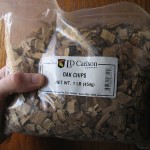
constraints (oak barrels can be very expensive compared to stainless steel tanks), space limitations, or the need to purchase new barrels on a relatively frequent basis compared to stainless steel tanks in order to achieve the desired effect on the finished wine.  These issues present the need to utilize less expensive alternatives; specifically, oak chips.  Oak chips may be added to wine fermenting in stainless steel tanks, and have been found to impart similar characteristics into the finished wine as an oak barrel.

There are many factors that influence which volatile compounds are extracted from oak into wine, and how much of each compound is extracted, including (but not limited to) the length of time the wine is in contact with the oak, the geographic origin of the wood, the wood seasoning, and the toasting of the wood.  The type of wine (i.e., varietal or blend) can also have a major influence on the volatile extraction of the oak wood.  Volatiles most commonly extracted from oak wood that have a significant impact on wine aroma, flavor, and quality are: lactones, volatile phenols, and phenolic aldehydes.

In regards to the specific volatiles from oak that influence wine aroma and flavor, the following are most commonly found:

  • Furfurals (dried fruits)
  • Guaiacol (burnt tones)
  • Whisky lactone (woody and coconut)
  • Eugenol (cloves, smoke, spice)
  • 4-ethylphenol (barnyard, bandaid, mousy – Brettanomyces)
  • 4-ethylguaiacol (cloves, smoke, spice, etc)
  • Vanillin (vanilla tones)
  • Syringaldehyde (vanilla)

Photo by inspector_81: http://farm6.staticflickr.com/5165/5218552773_478a515be5.jpg

The goal of the study presented today was to examine the differences (if any) in volatile aromatic compounds of wine after using oak chips from different origins and under different toasting conditions.


Methods

Four wines were used in this experiment:

1) varietal Cabernet Sauvignon

2) varietal Blaufränkisch

3) red blend

4) white blend

Oak chips used in this experiment were:

1)      American oak

  • Medium toasting
  • High toasting

2)      German oak

  • No toasting
  • Medium toasting
  • Premium toasting

3)      French oak

  • Medium toasting
  • Medium-plus toasting
  • High toasting

Nine 1-liter glass bottles of each wine closed with crown cork were the vessels used in this experiment.  One of the bottles served as the no oak control, while the other 8 contained 1g/dm3 of each type of oak chip.  Oak chips were kept in the bottles for 30 days in the dark at 4oC. Bottles were shaken (not stirred….ha ha) twice a week to aid in the oak volatile extraction.

Volatile compounds were measured and analyzed using GC-MS techniques.

Results

Furfurals

  • Furfural concentrations varied the greatest out of all of the volatiles found in oak chip treated wines.
    • Furfural and 5-methylfurfural concentrations increased in all oak chip-treated wines.
    • The highest increase of furfural was detected in red wine samples treated with French oak chips with high levels of toasting.
    • The highest increase of 5-methylfurfural was found in wines treated with American oak chips under medium toasting, and French oak chips under high toasting.
    • The smallest increase and/or decrease in furfurals was found in wine samples treated with untoasted German oak chips.

Lactones

  • Trans-whiskeylactone increased in all wine samples treated with oak chips.
    • Cis-whiskeylactone levels were too small for statistical analysis.
    • The highest increase of trans-whiskeylactone was found in wines treated with medium toasted American oak chips.
    • The lowest increases of whiskeylactones were found in wine samples treated with high or premium toasted oak chips.

Eugenol

  • Levels of eugenol increased in all wines treated with oak chips with the exception of Cabernet Sauvignon.
    • Cabernet Sauvignon wines treated with untoasted and premium toasted German oak chips saw decreases in eugenol levels.
    • Eugenol increased in wines made from American oak chips with medium toast.
  • Trans-isoeugenol levels were highest in blended wine samples with French and American oak chips with medium and high toast.

Guaiacol

  • Levels of guaiacol were mostly affected by toasting level.
    • Highest levels of guaiacol were found in wine samples treated with high toasted oak chips, regardless of the origin of the wood.
    • Untoasted oak chips had no effect on guaiacol and 4-ethylguaiacol in wine samples.

Ethylphenol

  • Oak chips had no impact on 4-ethylphenol levels in wine samples.

What does this all mean?

According to the results of this study, which contradict the results of some other studies, the authors were not able to determine the origin of the oak chips used in a wine sample based on the volatile composition.  The largest influencer of volatile composition in the wine samples appeared to be the toasting levels.  Furfural, guaiacol, and whiskeylactones were influenced by the degree of toasting, while furfural and guaiacol increased with toasting intensity.

Though geographic origin of the oak chips did not have a significant influence on volatile composition of sample wines, the authors claimed that the highest

Photo by Franco Folini: http://farm1.staticflickr.com/113/294928909_01ab1f5696.jpg

increase in desirable volatile compounds in wine were found in wines made from French oak chips with high levels of toasting.  I’m a little perplexed by this statement, as when something is not significantly different, one cannot say with confidence that one treatment was superior to another.  It’s possible that the levels of these volatiles in wines treated with high toasted French oak chips trended toward having more desirable levels of volatiles than all other treatments, but other than this general statement in the conclusions, it was not immediately clear to me how this was true based on the reported results.

I’m also not entirely convinced that the results of this study are representative of a real world scenario.  First of all, the oak chips were placed directly into the bottle and left for 30 days.  Never would this method ever take place in the real world, with the addition of oak chips occurring at some point during the aging process while still in stainless steel tanks.  I suppose the shaking of the bottles was supposed to imitate the micro-oxygenation process in the tanks, but without evidence that this is an appropriate method substitution, I’m not convinced the wine is being exposed to the same amount of oxygen that it would be while aging in the tank.

I believe the conditions of the wine samples in this experiment are markedly different than samples that are kept in stainless steel tanks with micro-oxygenation.  This sort of variation would likely have a significant effect on the volatile composition of the finished wine, thus making the results of this study not repeatable in real world situations, and certainly not comparable to the volatile composition of wines made in steel tanks with micro-oxygenation.   I believe this is part of the reason why the authors were not able to detect differences in geographical origins of oak chips based on the volatile composition of the wine when other studies using more realistic methods could.

I don’t mean to sound all negative.  Clearly this study showed that oak chips and toasting do have influence on the volatile composition of wine, though again, I am not convinced the exact levels and trends are completely accurate based on the methods employed.  I think the study is a good start, but it needs to be repeated under more realistic aging conditions.

What do you all think of this study?  Do you agree or disagree with my thoughts on the study methods?  Do you see any other issues with the study that you’d like to discuss?  Maybe you loved the study—feel free to share that, too!  Please leave your comments and join in the discussion!

Source: Návojská, J., Brandes, W., Nauer, S., Eder, R., and Frančková, H. 2012. Influence of different oak chips on aroma compounds in wine. Journal of Microbiology, Biotechnology and Food Sciences 1(4): 957-971.